

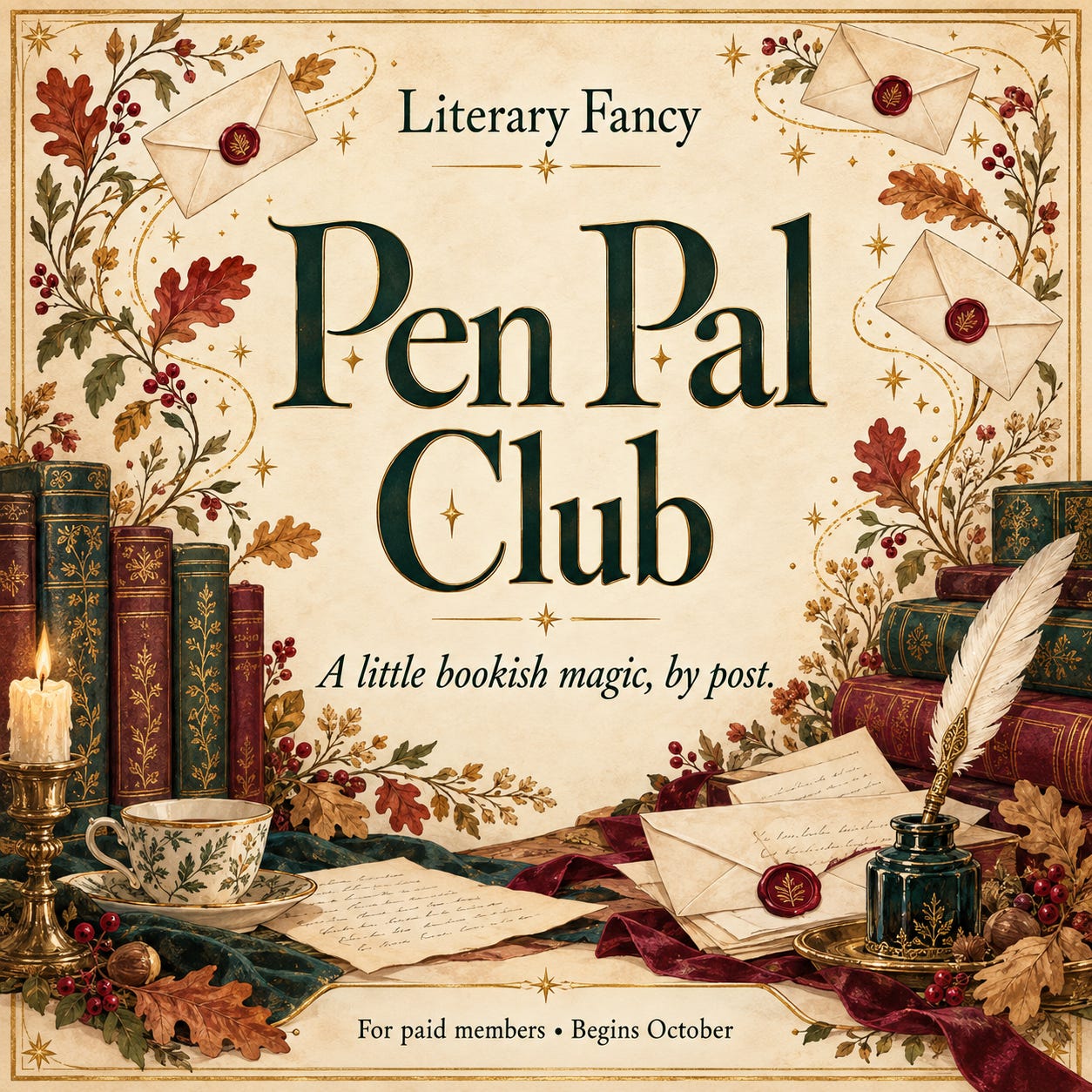
A new benefit for paid members, beginning this October: personal matches, monthly prompts, and an excuse to use the good stationery.
There is a particular kind of hope involved in opening an envelope with your name written on it by hand.
Someone sat down. Someone thought of you. Someone found a stamp. A small triumph of both affection and logistics.
I would like more of that. More small, deliberate gestures of friendship. More conversations about books that have room to wander. More mail that does not require me to pay somebody.
So, this October, I’m starting the Literary Fancy Pen Pal Club, exclusively for paid members. I’ll personally review your signup, match you with another reader, and introduce the two of you by email. You’ll get a prompt for your first letter and a fresh prompt each month to keep the conversation going.
If you want to join the first October matching round, become a paid member and fill out the signup form by Friday, October 2, 2026. If you’re already a paid member, you only need to fill out the form.
The form to fill out is already in the member’s chat and Member’s library along with your other freebies.
Member's Library

Your complete paid-member archive, organized by what you want to do today. Choose your next classic, find a companion guide, improve how you read, or watch a class.
What the Victorians understood about a letter

I have no wish to acquire a Victorian household. The laundry alone would end me. But a regular correspondence with someone who understands why a fictional conversation has occupied my thoughts for three days? That I can support.
The Victorian world of letters had a practical breakthrough behind it. From January 10, 1840, a letter weighing up to half an ounce could travel anywhere in the United Kingdom for a penny. That affordable national rate helped open up the possibilities of correspondence. Catherine J. Golden’s history of the Penny Post, published by the Smithsonian, page 121
The familiar Penny Black followed that May. The tiny portrait of Queen Victoria is still remarkably recognizable; the Metropolitan Museum holds an unused block of four. The Met’s Penny Black collection record
Cheaper postage helped letter writing flourish. In a Smithsonian publication, scholar Catherine J. Golden describes the growth of correspondence and the flourishing market for writing desks, stationery, and other writing equipment. She also recounts Lewis Carroll’s practical advice to correspondents, including writing legibly and resisting the temptation to spend ages apologizing for a late reply. Golden’s essay on Victorian postal culture, pages 121–124
That last piece of advice feels particularly generous. You may begin a letter with the thing you wanted to say. Your opening paragraph does not need to serve as your defense before the Court of Delayed Correspondence.
Why I want to make room for letters
What appeals to me about a letter is the scale of its attention. You are writing to one person. You can follow a thought for a while. You can tell the small story that would never justify an announcement: what you noticed on your walk, what you’re reading, the sentence you kept returning to after you put the book down.
And you leave room for an answer.
A book recommendation becomes more interesting when it arrives with a little of someone’s life attached. “I read this during a difficult winter.” “My grandmother loved this author.” “I thought I would hate it, and now I am defending the heroine to people who did not ask.” That is the sort of conversation I would love to help begin here.
There is pleasure in having something you can keep, too. A folded page tucked into a book. A postcard on the shelf. Another reader’s handwriting becoming familiar.
You don’t need beautiful handwriting, special paper, or an exciting life. Ordinary paper is welcome. A typed letter sent through the post is welcome if that works better for you. A short, friendly letter gives the other person plenty to answer.
How the Pen Pal Club will work

You tell me a little about yourself. The signup form asks about your reading interests, your country, the language you’d like to write in, your preferred pace, and whether you’re comfortable paying for international postage. Please use the email associated with your paid Literary Fancy membership so I can confirm eligibility.
I personally review the signups and make the matches. I’ll consider the practical details first, then look for literary interests that might make a good conversation. I will do the organizing and make the introductions for you.
I send one introduction email to each pair. It will share your chosen names and email addresses, mention a bookish connection from your responses, and include a first-letter prompt. You’ll agree to that limited sharing when you sign up.
You exchange postal addresses privately. I won’t ask for your home address in the signup form or distribute a member address list. Once you and your pen pal have said hello and are comfortable, you can share a mailing address directly with each other. Remove me from the email before exchanging addresses.
You start writing. Around one letter a month is a useful starting point, and you can agree on a different rhythm together. You supply your own stationery and postage. You’re welcome to keep things as simple as a page, an envelope, and a stamp.
What happens each month
I’ll run a new matching round each month for new participants and members requesting a replacement or an additional pen pal. Existing pairs can keep writing to each other for as long as they both wish. You won’t need to sign up again every month to keep your current correspondence going.
I’ll also share a fresh monthly prompt. Use it when you want a starting point; follow your own conversation when you have one.
This is a small program, so I may not have a compatible partner for everyone in every round and if that’s the case, I will write to you myself! :) Paid membership needs to be active when I make a new match.
If a partner doesn’t reply, your circumstances change, or the match isn’t a fit, email me at literaryfancy@gmail.com or message me on Substack. You can ask to pause, leave, or request another match. Please keep one another’s contact details and letters private unless you have permission to share them.
Your first letter
Here is the October prompt:
Tell your pen pal about a book that has felt like good company. Where were you when you read it, what stayed with you, and why would you put it into another reader’s hands?
Introduce yourself, give them a small glimpse of your reading life, and leave them a question to answer. You might also mention the book currently sitting beside your chair. We all know there may be several. This is a sympathetic audience.
Join the October matching round
The Pen Pal Club is included with paid Literary Fancy membership. To take part in the first round, become a paid member and submit your signup by Friday, October 2, 2026.
Already a paid member? Go straight to the form on this page on the top. Joining after this first deadline? You can sign up for a later monthly round.
Member's Library

Your complete paid-member archive, organized by what you want to do today. Choose your next classic, find a companion guide, improve how you read, or watch a class.
I’m looking forward to making these introductions. Somewhere in this community is another reader with a book to tell you about, a question to ask, and possibly an alarming quantity of unused stationery.
Let’s give them someone to write to.
Your literary friend,
Karen
