


Can I tell you what I think is actually happening when someone says they do not have time to read?
They have time. What they do not have is the belief that anything they could pick up in the next twenty minutes is worth the investment of sitting still for.
Because the books they learned about in school were all 600 pages and assigned and no one told them why. Because BookTok has made every reading goal into a performance. Because the last classic someone handed them started with three pages of genealogy and they did not make it past the second cousin.
The issue is not time. The issue is trust.
This list is for that person. These are 20 classic books under 250 pages, none of which will waste your time, all of which will do something to you that you did not expect from a book you can finish in a weekend. Some are under 150 pages. One is 87 pages and it will change how you think about death and grief and whether language can hold either of them.
No genealogy. No 50-page whale anatomy tangents. Just the books.
The List
1. The Metamorphosis by Franz Kafka (111 pages)

Gregor Samsa wakes up as a giant insect. His main concern is that he is going to be late for work. His family’s main concern, once they get past the initial shock, is that he is no longer financially useful to them. The metaphor is not subtle and that is intentional. Kafka was not writing a story about a bug. He was writing about what happens to a person when they stop being productive and whether love survives uselessness.
It is funny in the way that extremely dark things are funny when they are written with perfect precision. You will read the first paragraph and laugh. Later you will think about why you laughed.
2. The Strange Case of Dr Jekyll and Mr Hyde by Robert Louis Stevenson (141 pages)

Everyone knows the twist. The good news is that the twist is not the point. What Stevenson is actually writing about is Victorian respectability and the specific violence of maintaining a perfect public self while another self accumulates underneath. Hyde is not the monster. He is what happens when Dr Jekyll refuses to acknowledge what he is.
Read it in one sitting. It was written to be read that way.
3. The Yellow Wallpaper by Charlotte Perkins Gilman (65 pages)

A woman is prescribed rest cure for postpartum depression by her physician husband. She is taken to a country house. She is not allowed to write or work or think. She starts studying the wallpaper in her room. What she finds there is one of the most effective pieces of psychological horror in American literature, written in 1892 by a woman describing her own treatment.
Gilman wrote this after surviving the same prescription. Her doctor told her never to touch pen or paper again. She published this story and sent him a copy.
4. Of Mice and Men by John Steinbeck (112 pages)

Two migrant workers, George and Lennie. One dream: a little land, some rabbits, someplace of their own. Steinbeck wrote this as a play-novella, which means every scene is precise and nothing is wasted and the ending is coming for you from page one whether you see it or not.
The line “tell me about the rabbits” will stay with you. I am sorry in advance.
5. Giovanni’s Room by James Baldwin (159 pages)

An American man in Paris. A love affair he cannot name in the culture he comes from. A room that contains everything he refuses to be honest about. Baldwin wrote this in 1956, as a Black American man, about white American men, specifically because he wanted no one to be able to dismiss it as a story about race. He wanted it to be about shame and what shame does to love and whether either can survive the other.
It is devastating and precise and short enough that there is nowhere to hide from what it is saying.
6. Ethan Frome by Edith Wharton (96 pages)

Rural New England. A man trapped in a loveless marriage. A woman he cannot have. A sled. Wharton wrote this as a controlled study in what happens to people when every option they have is impossible and the only choices left are terrible ones.
People call this bleak. It is. It is also one of Wharton’s most structurally perfect books and the bleakness is the argument she is making about what poverty and obligation actually do to human beings.
7. Passing by Nella Larsen (188 pages)

Two Black women who grew up together. One has been passing as white. The other has not. They meet again as adults and the tension between them is about identity and desire and the violence of choosing which self to be in public, and it is all happening under the surface of extremely polished social interactions.
Larsen published this in 1929. It was largely ignored for decades. It is one of the finest psychological novels in American literature.
8. The Pearl by John Steinbeck (90 pages)
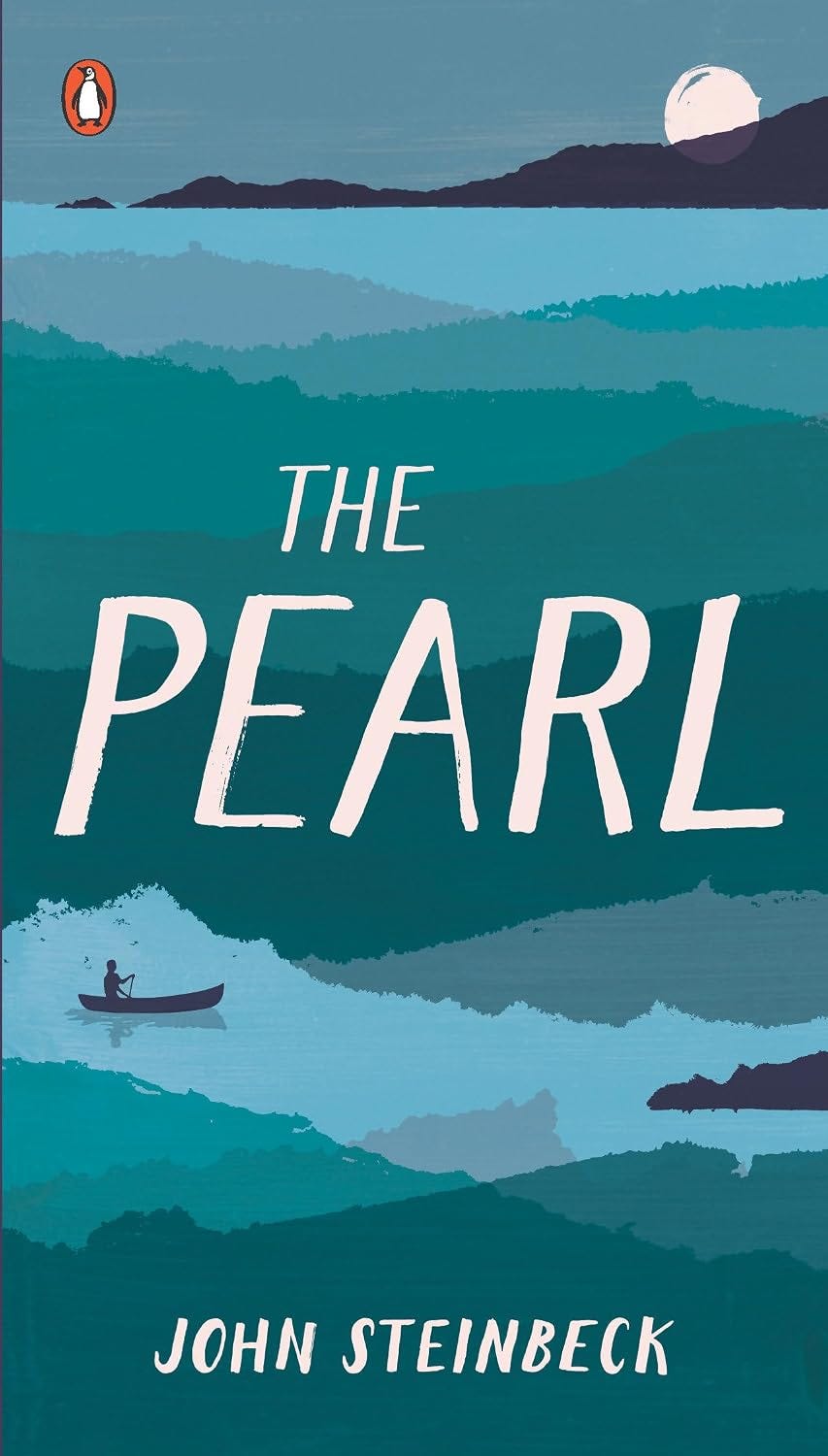
A pearl diver finds the pearl of the world. You would think this is good news. It is not good news. Steinbeck wrote this as a parable and the parable is about what happens when a poor person suddenly has something that a wealthy system wants to take from them, and how the system goes about doing it.
90 pages. You can read it in an afternoon. You will be thinking about it for considerably longer.
9. The Awakening by Kate Chopin (128 pages)

Edna Pontellier is a wife and mother in 1899 New Orleans who begins to notice that she is a person with desires that exist outside her assigned roles, and then begins to act on this information. Her society finds this intolerable. Her husband finds this confusing. Her children have needs. Chopin wrote this in 1899 and it was condemned as immoral and then largely forgotten for 70 years and then rediscovered in the 1970s by people who understood what she was actually describing.
The ending is one of the most argued-about in American literature. I have opinions. You can find them in the members archive.
10. Animal Farm by George Orwell (112 pages)

The farm animals overthrow the farmer. They establish a system based on equality. The pigs, who are more equal than the others, slowly begin to resemble exactly what they replaced. Orwell wrote this in 1945 and publishers kept rejecting it because they did not want to offend Stalin, which is its own argument about the book’s accuracy.
It is a children’s story that is not a children’s story. You already know the line about four legs good, two legs better. You should read it anyway.
11. Breakfast at Tiffany’s by Truman Capote (179 pages)

Holly Golightly is not the Audrey Hepburn version. She is younger, stranger, more deliberately unknowable, and the novella is told by a narrator who is in love with her and does not fully understand her and is honest about both of these things. Capote wrote her as a study in performed freedom: someone who has decided that not belonging to anything is the only protection available to her.
The movie is wonderful. The book is better and weirder and does not resolve the way the movie does, which is the point.
12. The Old Man and the Sea by Ernest Hemingway (127 pages)

An old fisherman hooks a giant marlin. The fight takes three days. Nothing about this is actually about fishing. Hemingway is writing about what it looks like to do something with complete commitment when the outcome is already uncertain, and whether the doing is enough on its own.
People who find Hemingway unbearable often find this one different. It is quieter and less interested in performing masculinity and more interested in what happens to a person alone with something larger than themselves.
13. Their Eyes Were Watching God by Zora Neale Hurston (192 pages)

Janie Crawford lives three lives across three marriages and the novel is her sitting on a porch telling her best friend what happened. Hurston wrote in Black Southern vernacular dialect, which was controversial in 1937 and the controversy was largely from people who felt it was undignified, which is its own conversation about dignity and who gets to define it.
The prose is extraordinary. The love story in the middle of this book is one of the finest in American literature. And the ending is one of those that has a completely different meaning on reread.
14. We Have Always Lived in the Castle by Shirley Jackson (146 pages)

Merricat Blackwood is one of the most unreliable and compelling narrators in 20th-century fiction. She lives with her sister Constance and their uncle Julian in a house most of the village considers cursed, for reasons that become clear. Jackson writes dread the way other people write weather: as a fact of life, simply present, requiring no explanation.
If you have only read The Haunting of Hill House, this is different and it is in some ways more disturbing because the horror is entirely internal and almost cheerful.
15. The Great Gatsby by F. Scott Fitzgerald (180 pages)

Jay Gatsby throws extraordinary parties and never attends them. He is in love with a light at the end of a dock. He has built an entire life around the theory that the past is retrievable. Nick Carraway watches all of this and mostly fails to say what he is actually thinking, which is that he finds Gatsby both ridiculous and the most alive person he has ever met.
People often say Gatsby is about the American Dream. It is, in the way that a crime scene is about the crime. The American Dream is the mechanism of the destruction. Fitzgerald is documenting the aftermath.
16. Sula by Toni Morrison (174 pages)

Two Black women in a small Ohio town. Childhood friends. Diverging lives. One stays. One leaves and comes back. What Morrison is writing about is female friendship as a primary relationship, as complicated and as capable of betrayal as any other love, and she is doing it in prose so good that rereading it feels like new reading.
This is the Morrison to start with if you found Beloved overwhelming on a first attempt. It is shorter and its structure is cleaner. Read this first and then go back to Beloved.
17. Miss Lonelyhearts by Nathanael West (115 pages)

A newspaper advice columnist reads the letters sent to him and cannot shake the people behind them. He is supposed to write back with comfort. He finds he has nothing. West wrote this in 1933 as a dark comedy about the gap between what people need and what institutions can provide, and it is savage and funny and 115 pages of the most compressed damage in American literature.
Not widely taught. Should be. Extremely relevant now.
18. A Room With a View by E.M. Forster (230 pages)

Lucy Honeychurch is in Florence, which is the right place to have all the wrong feelings. She meets a man who says exactly what he thinks, which is considered inappropriate. She is engaged to a man who considers her an aesthetic object. Forster is writing a comedy about the specific violence of English Edwardian repression and the specific possibility that Italy might break through it.
This is the warm one. Read this when you want to feel hopeful about people.
19. The Stranger by Albert Camus (123 pages)

Meursault attends his mother’s funeral and does not cry. He then goes to the beach and something happens and he goes on trial and the trial is not really about what he did but about whether he cried at his mother’s funeral. Camus is making an argument about the relationship between social expectation and moral judgment, and the argument is that we punish people primarily for refusing to perform grief on schedule.
This is short and reads fast and you will spend a long time arguing with it afterward, which is what Camus intended.
20. Franny and Zooey by J.D. Salinger (201 pages)

Franny Glass is having a crisis. Not a dramatic one. A quiet one, in a restaurant, over a chicken sandwich, where she suddenly cannot understand why anyone is doing any of the things they are doing or whether any of it means anything. Her brother Zooey has opinions about this. Their conversation takes up most of the book.
This is the one that Literary Fancy readers find most surprising. It does not look like a classic intervention narrative. It is one anyway.
Ready to reset your attention?
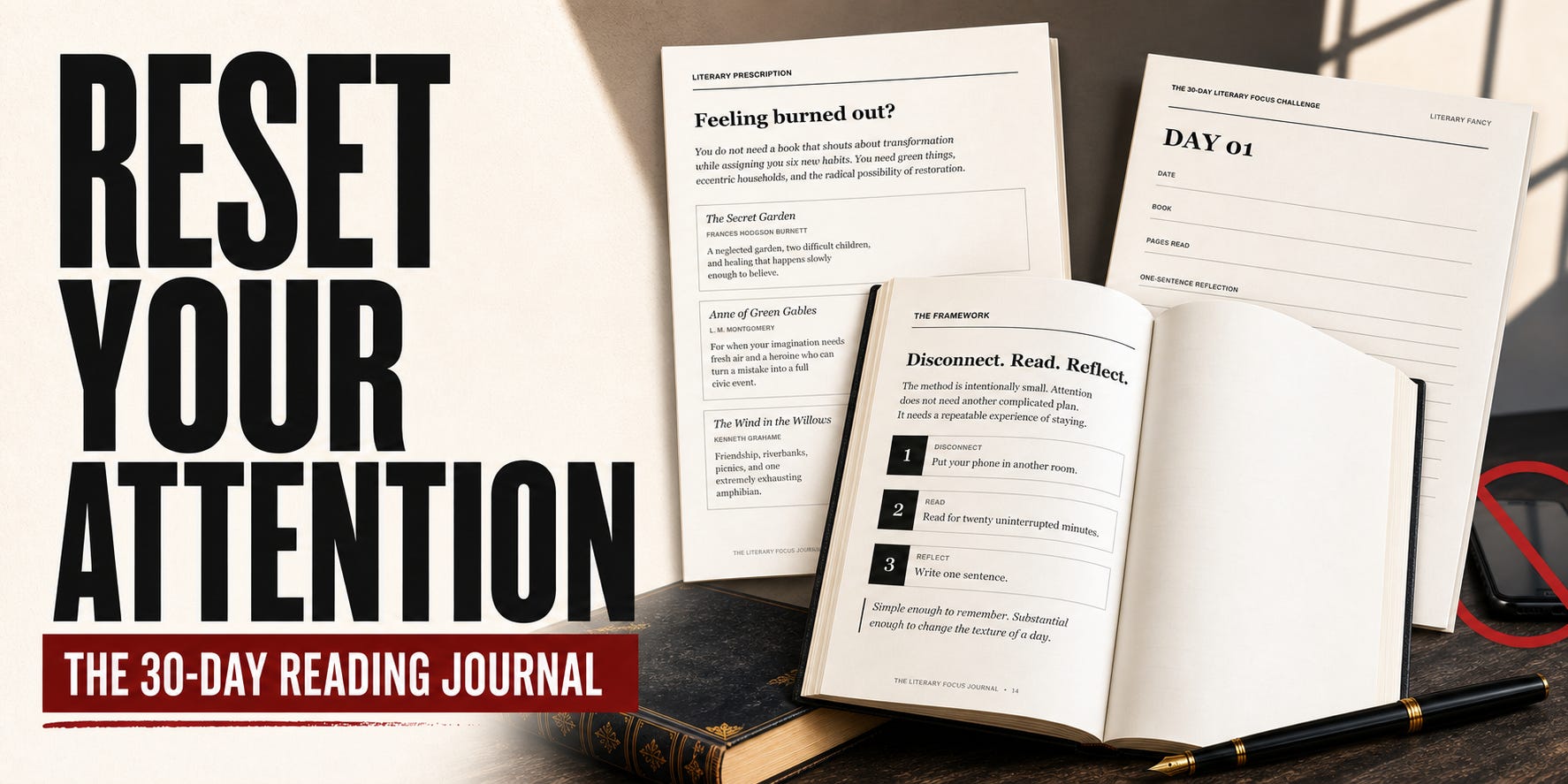
The Literary Focus Journal is a 30-day reading reboot for anyone who misses being able to sit with a book without checking their phone every six minutes.
You’ll get the simple Disconnect, Read, Reflect method, genuinely gripping book recommendations, and daily pages to rebuild your focus without turning reading into another productivity project.
Paid members can download the journal, webinar replay, slides, companion guide, and the complete Members Library now.
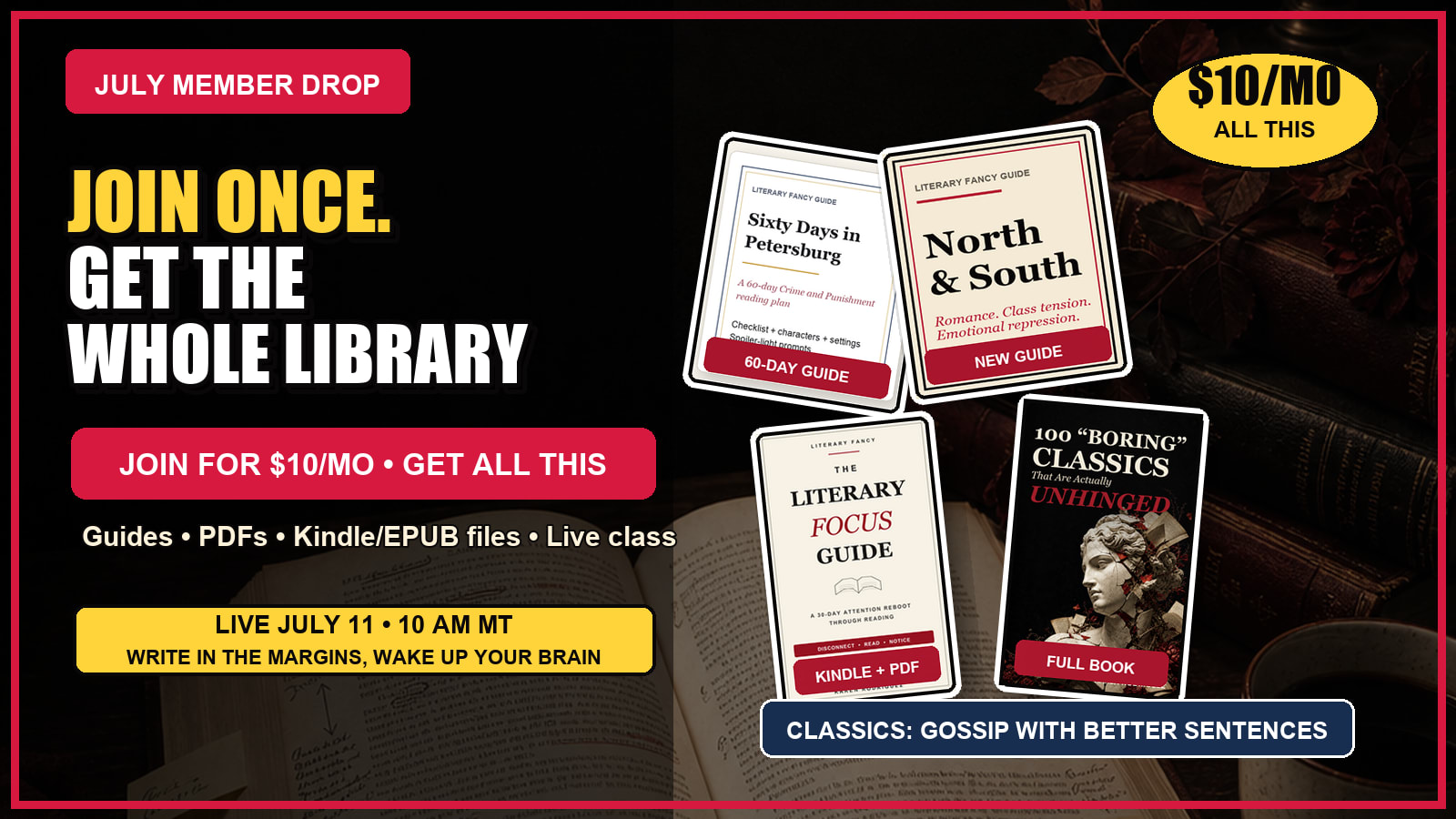
Join Literary Fancy as a member this July and get the full member drop waiting in the library:
Crime and Punishment 60-Day Reading Guide
North and South Reading Guide
The Literary Focus Guide in PDF and Kindle/EPUB formats
100 “Boring” Classics That Are Actually Unhinged in all available versions
The Unhinged Classics companion guide
The full Literary Fancy member archive
July 11 live class: Write in the Margins, Wake Up Your Brain
Membership is $10/month, which is deeply rude math considering one paperback alone costs more than that. If you want classics to feel less like homework and more like gossip with better sentences, come join us.
Still reading. Still here.
Karen
Thank you for this list. Two weeks and I am still getting over Ethan Frome. The thing reads like you're tied to the railroad tracks, and nobody saves you.
I've said this before (at my age you always have to say that or people think you're getting senile) but everyone thinks they know "A Christmas Carol" so they don't actually read it. It's full of delicious and horrific and scary and brilliant things.
Maybe that's the secret to getting high schoolers to read again: choose shorter but classic novels. Of Mice and Men is one of the few that still remains on many classroom lists.